The Dai Mai: The Belt That Holds the Psyche
By Mathew William Carver, MSAOM. Founder, Barn Life Recovery
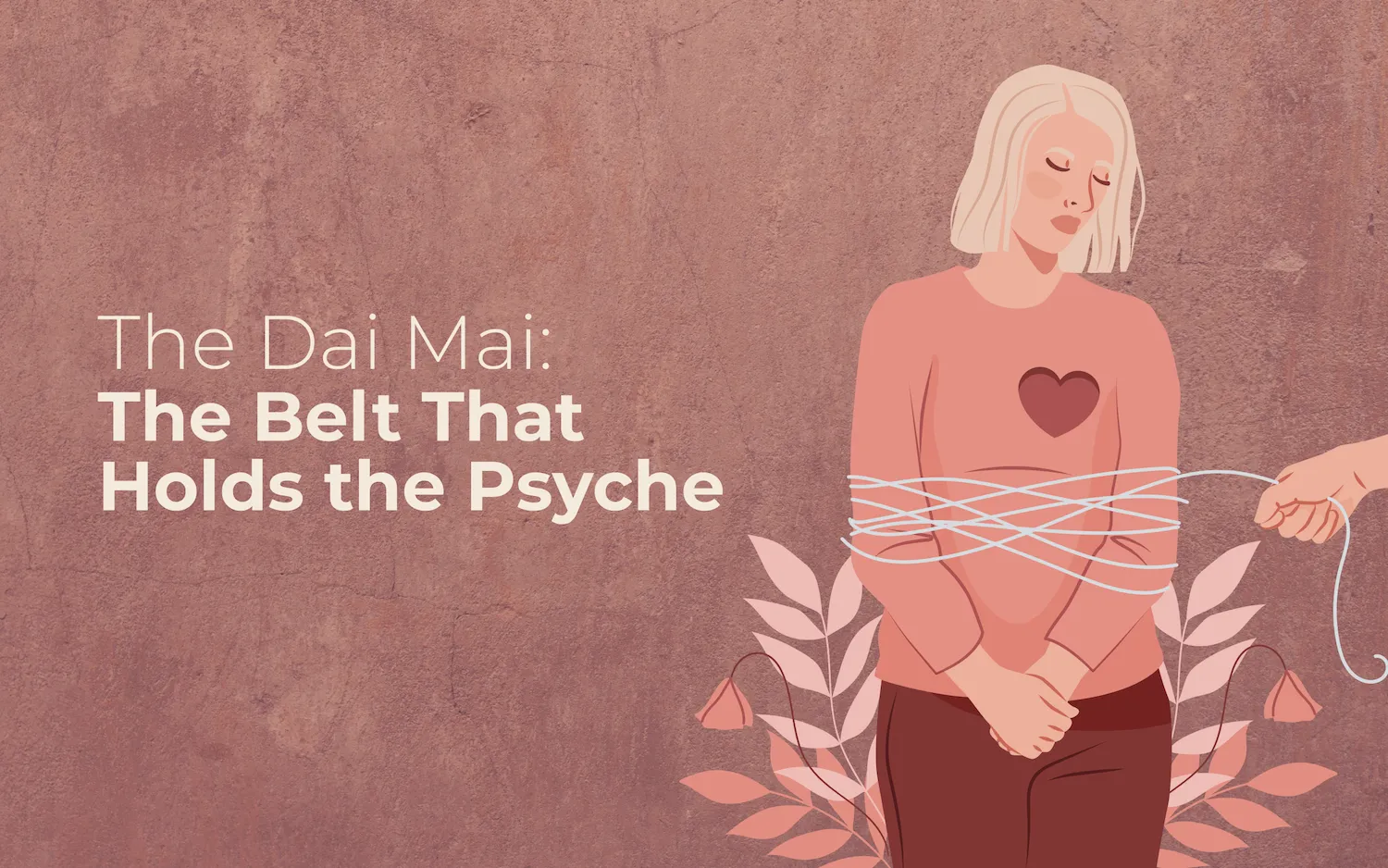
In Traditional Chinese Medicine, there is a vessel that does something no other channel does. It’s not jostling about running up and down like a highway. It runs around. It carries the body like a belt, keeping all together. This is the Dai Mai—the Belt Vessel.
When healthy, the Dai Mai helps anchor and support the body and helps to integrate everything. And when it gets disturbed, life starts to feel precisely the opposite: tight, heavy, stuck and emotionally restrained. Having been in clinical practice and run mental-health facilities for years, I have seen the Dai Mai as perhaps one of the most under-appreciated bridges between emotional experience and somatic memory.
The Dai Mai as a Psychological Container
Unlike the twelve main meridians, which move Qi vertically, the Dai Mai regulates the integration horizontally. It binds the upper and lower body, to enclose movement, digestion, reproduction and emotional flow. Clinically, we’ll see a very particular picture when the Dai Mai becomes congested or deficient: a feeling of pressure or tightness around the abdomen or waist, heaviness in the body, digestive irregularity, pelvic or low-back pain—and, more importantly, emotional holding. Frustration that never moves. Resentment that settles into the hips. Trauma that doesn’t “feel” at all anymore “in the mind” — but in the body itself. In the mental world, this translates into a state of emotional stasis with somatic symptoms: patients who know what they’re feeling, but can’t let it go. The nervous system is activated, but the body has lost its capacity to discharge.
Here’s where the Dai Mai talks. The Dai Mai as a source of mental health value from a Chinese medical lens, the Dai Mai is deeply influenced by the liver, spleen and kidney systems – the organ systems that underlie emotional regulation, digestion of experience and long-term resilience. At a time of stress, trauma or persistent emotional suppression, the Dai Mai often serves as a storage location. The body “belts in” unresolved material. What we observe clinically is disturbingly consistent: emotional restrictions paired with belly tightness, disordered digestion, pelvic heaviness or low back instability. Once the Dai Mai is treated and starts to release, patients often report feeling a sense of emotional lightness, clarity, maybe even sudden insight — usually without having to talk it through themselves. These observations are well established in classical and postmodern clinical practice and reinforce the Dai Mai’s role in regulating dampness, constraint, and structural balance.
How We Use This at Barn Life Recovery
Here at Barn Life Recovery we’re not seeing mental health as something that happens with only our own minds. We consider feelings of emotional distress a system phenomenon—neurological, psychological, and physiological. We employ the Dai Mai assessment and treatment as part of a comprehensive East-West paradigm in our integrative model. When relevant, we use acupuncture protocols that regulate the belt vessel, usually focusing on the GB-26, GB-27 and GB-28, while distal points are typically selected to address emotional suppression, gastrointestinal imbalance, or trauma that may manifest in holding patterns. Such interventions are in combination with psychotherapy and psychiatric care and structured recovery programming. The end result is not simply alleviation of symptoms — but reintegration. Patients usually regain a perceived sense of inner resilience, improved posture, less trouble with digestion, less anxiety and a newly minted ability to process feelings without losing control.
What Knowledge Will Be Acquired for Success
I have a Master of Science in Acupuncture and Oriental Medicine (MSAOM) from South Baylo University, but as profoundly, I have worked long years to run and build mental-health treatment centers. That long view — observing how the emotional pattern of a person sinks into the body over time and how the body responds when those patterns are finally addressed — has informed how we practice.
The Dai Mai teaches you this simple but deep truth: that which cannot be metabolized emotionally will be carried physically. Life turns when the belt loosens. At Barn Life Recovery, this is a not-so-secret understanding. It’s clinical. It’s lived. And it’s one way we help people not just cope — but reconnect with themselves, from the inside out.